On a cold January morning, the most valuable thing a Brooklyn grocery store can own may be a roof that grows lettuce. The Whole Foods at Third Street and Third Avenue in Gowanus carries a commercial greenhouse on top of the building itself. That one design choice changes the questions an analyst should ask about freshness, shrink, and what "local" means on a produce label. This case study explains the model, traces where it breaks, and shows how to audit the claims it invites.
What's Inside
- Co-Located Rooftop Agriculture at Third and 3rd: The Verdict Up Front
- Why Brooklyn's Cold-Chain Bottlenecks Forced a Vertical Solution
- From Freight Elevator to Produce Aisle: Inside the Gowanus Harvest Cadence
- Assortment Realities and the Structural Limits of Rooftop Hydroponics
- How Retailers and Smart Shoppers Can Audit Local-Sourcing Claims
- What Zero-Mile Sourcing Looks Like on a Tuesday Morning in Gowanus
Co-Located Rooftop Agriculture at Third and 3rd: The Verdict Up Front
Co-located rooftop agriculture means a commercial hydroponic greenhouse built into the structure of a retail grocery store. The farm sits inside the same building envelope as the shelves it supplies. A greenhouse on a warehouse three neighborhoods away does not qualify, however local it may be. The defining feature is a harvest that can reach the sales floor without ever touching a public road.
Public launch descriptions place a 20,000-square-foot Gotham Greens greenhouse above the Gowanus supermarket and date its opening to December 2013. The sensible way to judge it is to count steps. List every transport, storage, and receiving handoff between the moment a head of lettuce leaves its growing channel and the moment a shopper picks it up. Then compare that count with the conventional chain.
The verdict is clear for one category and limited for everything else. For fragile leafy greens and culinary herbs, supplying the store below removes the middle-mile journey along with the handling, waiting, and temperature swings that degrade delicate leaves. For potatoes, grains, apples, winter squash, and the rest of the calorie-dense or long-cycle produce sold downstairs, the roof contributes nothing and was never designed to.
That makes the primary takeaway narrower and more useful than the marketing tends to suggest. The value of rooftop integration lies in harvest-to-shelf velocity and in keeping greens on the shelf steadily through Northeast winters. Total store volume is the wrong yardstick. The 20,000-square-foot roof works as a winter greens buffer above a grocery store and cannot stand in for the acreage behind the potatoes, grains, and orchard fruit sold below it.
One more distinction runs through the rest of this piece. Greenhouse production, deliveries to the downstairs store, and deliveries to other stores are three separate quantities. Knowing how much the roof grows tells you nothing about what share of the downstairs produce section it fills.
Why Brooklyn's Cold-Chain Bottlenecks Forced a Vertical Solution
Follow a clamshell of romaine through the conventional system and the case for a rooftop farm builds itself.
It starts in a growing region, often a West Coast or Southern valley during the colder months. It moves to a packing operation, where field heat is pulled out and the product is boxed. Then comes refrigerated linehaul. A California-to-New York produce movement covers roughly 2,800 to 3,000 road miles depending on origin and routing, which works as context for the scale of the trip. Treat it as a general benchmark. No published itinerary ties that mileage to this particular store. After linehaul, the pallet lands at a regional distribution center, gets broken down and reassembled into store orders, and finally rides a city truck through bridge and tunnel crossings to a Brooklyn receiving dock.
Every handoff in that sequence adds time on a loading dock, a chance for a door to sit open, and another set of hands. Brooklyn's final approach brings its own risk. A jackknifed truck or a snowstorm on the approach roads can hold a delivery for hours, and leafy greens lose condition while they wait.
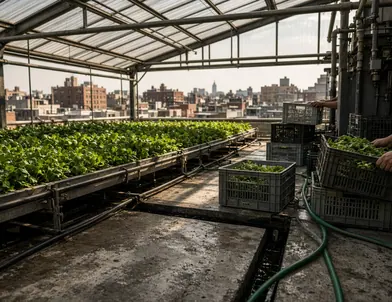
The Gowanus design answers that exposure with geometry. For the share of output allocated to the downstairs store, a roof-to-store transfer cuts out linehaul, the regional distribution center, and the city delivery leg entirely. Building the greenhouse into a newly constructed supermarket mattered as much as the idea itself. Engineers could plan structural loads, drainage, utilities, and receiving access from the first drawing, which avoids forcing a farm onto a roof that was never meant to carry one.
| Step | Conventional supply | Gowanus downstairs allocation |
|---|---|---|
| Growing | Distant field or greenhouse region | Rooftop hydroponic greenhouse |
| Packing | Regional packing operation | On-site packing |
| Long-haul transport | Refrigerated linehaul, roughly 2,800–3,000 road miles from California | None |
| Distribution center | Cross-docking and order assembly | None |
| City delivery | Truck through bridge and tunnel crossings | Internal building transfer |
| Store receiving | Dock receiving and check-in | Receiving and check-in still required |
Urban logistics observers have watched the site since its December 2013 opening to see whether co-location can offset metropolitan utility bills and construction overhead. Be careful with that history. Nobody has published a continuous, independently audited performance series covering those years. An honest cost comparison has to set avoided freight and handling against greenhouse capital costs, lighting, heating, ventilation, maintenance, and the expense of rooftop access. A version that tallies only the avoided trucks is incomplete.
From Freight Elevator to Produce Aisle: Inside the Gowanus Harvest Cadence
The physical workflow at Gowanus follows six stages: cultivation, harvest, on-site packing, internal transfer, store receiving, and shelf replenishment. The building makes a very short internal route possible. Greens grown in climate-controlled hydroponic channels can be cut, packed upstairs, and brought down to the receiving area without leaving the property.
The popular version of this story goes further. It describes a fixed daily morning harvest, a freight-elevator run to the dock, and same-morning placement on the shelf. That sequence is plausible given the layout, and it may well describe many days. Still, it should count as fact only once operating records or direct observation confirm it. The building allows that kind of speed. Only the logs can show whether the store actually delivers it each day.
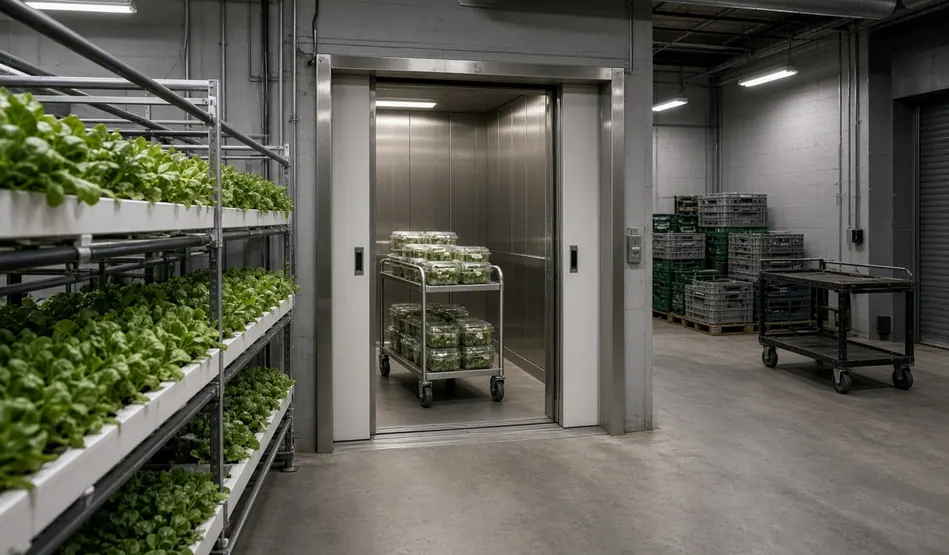
Compare that internal transfer with standard cross-docking. In a cross-dock, product comes off one trailer, sits briefly, and goes onto another. Each pause exposes leaves to temperature changes and moisture loss. A butterhead leaf or a basil sprig damages easily, and when cells lose water the tissue goes limp and starts to break down. Removing multi-day trucking takes away most of the opportunities for that damage.
One detail exposes lazy thinking about cold chains. Basil and lettuce do not want the same treatment. Basil is chilling-sensitive at the temperatures commonly used for lettuce, so blasting everything with maximum refrigeration can hurt the herb the store most wants to keep fresh. A good internal transfer keeps each crop in conditions suited to it, and colder is not always better.
It also helps to be precise about what "zero-mile" removes. A roof-to-store shipment has no public-road leg. The product is still harvested, packed, moved inside the building, received, and merchandised, and each of those steps can still go wrong.
To turn the claimed cadence into evidence, an analyst could run a receiving audit over 7 to 14 days. For each sampled lot, record harvest time, pack time, release from the greenhouse, store receipt, and shelf placement. Harvest-to-shelf time comes straight from those timestamps. This is a proposed audit design and not a study anyone has published for the site. A pack date by itself cannot establish when something was harvested.
Assortment Realities and the Structural Limits of Rooftop Hydroponics
Walk the Gowanus produce section and you will find carrots, cabbages, and apples, none of which came from upstairs. The economics of the roof explain why.
Crop selection in a compact greenhouse comes down to a few variables: saleable output per growing position per year, labor per pack, expected selling price, and how much environmental control the crop needs. Leafy greens and culinary herbs score well on nearly all of them. They turn quickly, sell at a premium, and can be replanted in the same position many times a year. Select vine crops can earn their space too. Root crops take up growing volume the system would rather use for leaves. Tree fruit occupies space through long establishment periods before it produces anything. Large heading brassicas hold positions for a long time and yield a bulky product at modest prices.
The building sets hard limits as well. A roof can carry only so much load, including water, growing media, glazing, and equipment. Ceiling height caps vertical growth. The 20,000-square-foot figure in public descriptions is gross greenhouse area. Aisles, packing space, and mechanical equipment all take a share, so the productive growing surface is smaller, though nobody has published a verified figure.
Climate puts pressure on both ends of the year. New York winters require heating, and humid summers require serious ventilation and dehumidification. Annual energy totals hide that seasonal swing. An analyst assessing the model should ask for monthly electricity and heating-fuel consumption alongside saleable packed weight, which shows how much the winter greens actually cost to produce.
The greenhouse against the regional field season
Hudson Valley and New Jersey field farms produce excellent greens through late spring and summer, then slow sharply as the ground freezes. The rooftop's advantage is consistency. It can keep producing lettuce in February, when nearby fields cannot.
That makes the greenhouse a supply stabilizer. It smooths the winter dip in local greens without trying to stock the store. A fair assortment comparison would set a documented winter period such as January through March against a summer period such as July through September, using the same crop and the same pack format. The rooftop's value should show up most clearly in the winter months.
Where the rooftop earns its keep
- Removes linehaul, distribution, and city delivery for the downstairs allocation
- Steady winter supply of fragile greens and herbs
- Less handling for crops that bruise and wilt easily
Where it reaches its limits
- Cannot grow root crops, grains, or orchard fruit economically
- Heavy heating and humidity-control demands across seasons
- Load, drainage, and height limits restrict growing space
How Retailers and Smart Shoppers Can Audit Local-Sourcing Claims
Audit the lot. The brand comes second.
The words "hyper-local" and "rooftop-grown" cover a wide range of supply arrangements across NYC retail. One brand can harvest at a store-level greenhouse and also distribute regionally from the same facility. A grower's name on a clamshell does not by itself show that the Third Street rooftop grew what is inside. The right sequence is to establish which greenhouse produced the item, then identify where it went and how it got there.
Where the Brooklyn facility's public launch descriptions get specific, they describe supply to the downstairs supermarket and to other local outlets. That second destination changes the zero-mile claim. The Third Street claim breaks at the dispatch split. Packs sent downstairs avoid a road journey, while packs allocated to another borough enter urban distribution. Product heading to a neighboring Brooklyn or Manhattan storefront gets loaded into a van or truck and joins the same congested streets the rooftop was meant to avoid. These are still short trips by any national standard, but they are road trips.
Describe those flows as what they are: off-site distribution. Mileage, vehicle type, travel time, or a share of output should be assigned only after reviewing delivery manifests or route records for those stores. Guessing at a van route and calling it a footprint figure is how sourcing claims grow beyond the evidence.
Shelf life needs the same discipline. A defensible comparison follows matched crop and pack formats through receiving, display, and discard. How a pack looks at checkout says nothing about how many saleable days it has left. A crisp leaf at noon can still fail on the second day in a home refrigerator if handling slipped somewhere.
For readers who order through Max Delivery, the 1-hour NYC grocery service, the same logic carries into the bag. A rooftop pack picked from the Gowanus shelf and carried a short distance by courier has had a very different journey from one that went to another borough before being picked. Asking which store a delivery was picked from is a reasonable first question.
- Production site: Confirm which greenhouse grew the lot; a brand name alone is insufficient.
- Destination: Separate downstairs deliveries from off-site deliveries and report them separately, since combining them makes a regional operation look entirely zero-mile.
- Transit distance: For off-site stores, pull manifests or route records before assigning mileage or travel time.
- Harvest-to-pack timing: Use recorded harvest and pack timestamps, never a pack date alone.
- Shelf-life gains: Track matched crop and pack formats from receiving through discard before claiming extra days.
What Zero-Mile Sourcing Looks Like on a Tuesday Morning in Gowanus
The Gowanus case shows what becomes possible when zoning, structural engineering, and retail merchandising line up on one building. The structure creates growing space. Internal receiving makes very short transfers possible. Merchandising turns that access into greens that stay on the shelf when outside supply falters. Each layer depends on the one beneath it.
The model also has clear limits on how far it travels. It relies on dense, relatively affluent foot traffic willing to pay for premium fresh greens, and on a building engineered for the farm from the start. An older NYC supermarket with a roof built only to keep the rain out faces a very different calculation in load capacity, drainage, usable height, and environmental-control costs. Replicating Gowanus elsewhere would be a new engineering and commercial project each time. For broader context on how controlled-environment growing fits into city food systems, the USDA urban agriculture and controlled environment production resources outline the federal framing.
Now picture a scene, offered here as an illustration and not as a documented visit. It is a Tuesday in February, and a coastal snowstorm is pushing wet snow sideways across Third Avenue. Somewhere out on the approach roads, trucks carrying greens from distant growing regions crawl or stop, which is the road exposure the rooftop was built to sidestep. Inside, a woman in a damp parka stops at the produce case and turns a pack of lettuce over in her hand. The leaves are firm and the seal is tight, with no liquid at the bottom. She catches the eye of a stocker restocking herbs and asks which lot this is, and whether it came from upstairs.
He checks the label against the receiving log. If the record shows a harvest that morning in the greenhouse above the ceiling tiles, her lettuce never rode a truck at all. She puts it in her basket and goes back out into the snow.