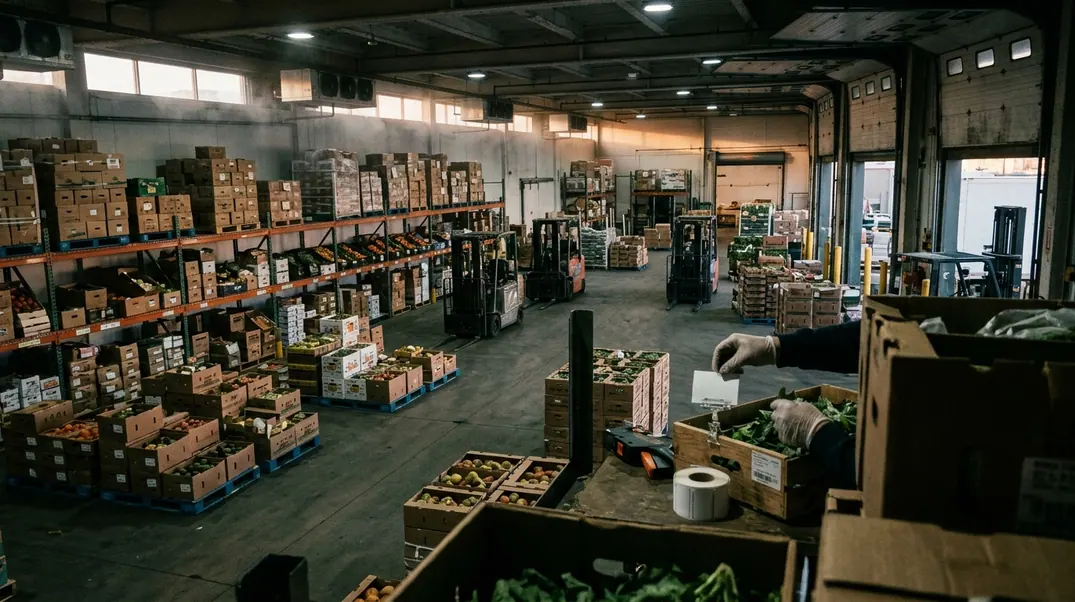

A Honeycrisp that costs $1.10 at a Chelsea corner store and 79 cents six blocks away at a supermarket did not come from two different orchards. It came from the same Bronx platform, on the same trading day, and then diverged over roughly 12 miles of traffic, one loading dock, and a doorway too narrow for a pallet jack. The gap between those two tags is a logistics record, and it can be read.
What's Inside
- The Landed Case Cost Comes First
- Reading a 40-Pound Carton Like a Buyer
- Dividing by 0.85: How Berries Reprice Themselves
- The Last Fifty Feet, From Curb to Display
The Landed Case Cost Comes First
Shoppers compare a shelf tag with a wholesale quote and conclude they are being fleeced. Buyers never make that comparison, because it skips three steps.
The working sequence runs like this: start with the landed case cost, convert the case into the units you actually expect to sell, add the cost of moving and handling that case, then divide by the units expected to survive the trip and the display cycle. Rent, refrigeration, card processing, and operating margin come afterward, layered on top of a number that already exists.
A standard apple carton weighs 40 pounds and is labeled by count: 88, 100, or 113 pieces. The count, not the weight, sets the starting unit cost. For produce replenished every one to three days, a single extra handoff from full case to split case, or from pallet to hand truck, moves unit economics before anything reaches the display.
Reading a 40-Pound Carton Like a Buyer
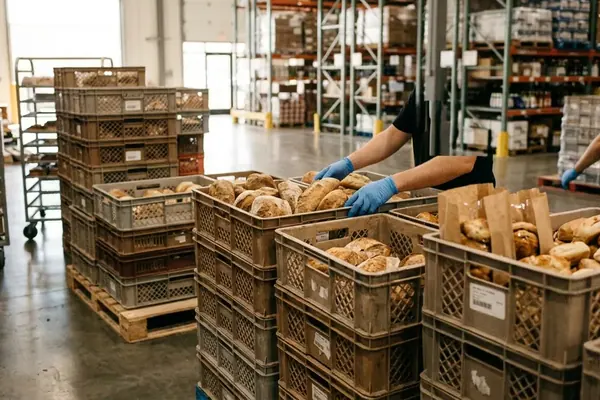
A quote from the Hunts Point Terminal Produce Market functions as a specification rather than a price: commodity, variety, grade or condition, origin, package weight, and count all have to match the item sitting in front of you. Quotations describe bulk units, a 40-pound carton, a count-sized carton, a pallet built from several cases. None of those converts cleanly into a per-piece tag.
Then come the adjustments. A retailer without a stockroom buys a broken case, and the terminal applies a premium for splitting the bulk unit. Delivery gets allocated to the carton. At receiving, crushed, undersized, and unsaleable pieces come out of the count, and the adjusted cost is divided by what was accepted. That figure is the floor beneath the shelf tag.
Timing matters as much as arithmetic. A quote observed on one trading day should be matched against a retail delivery arriving within about one to three days, since origin, size, condition, and availability shift between loads.
Dividing by 0.85: How Berries Reprice Themselves
Shrink covers inventory lost to spoilage, damage, and theft, and the common mistake is treating it as a surcharge added to the case. It works as a divisor.
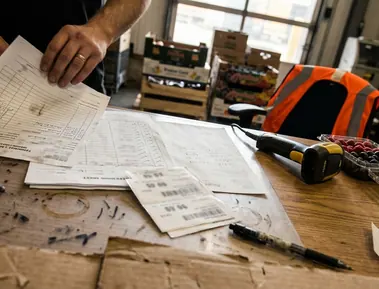
Assume a 15% expected loss on a delicate item. Only 85% of the purchased inventory is expected to sell, so the landed cost gets divided by 0.85. A $40 landed berry case therefore has to recover roughly $47 from the surviving clamshells before a minute of labor, a square foot of occupancy, or a cent of profit enters the calculation. Put another way, every $1.00 of landed cost becomes roughly $1.18 that must come back through the register. Adding 15 cents instead would understate the loss and quietly erode the margin.
Transit is allocated separately, by stop or by case, and it includes refrigerated vehicle time. Berries held near 32°F to 36°F deteriorate slowly, but repeated warming during curb unloading, stocking, and customer handling compresses a display cycle already measured in one to three days.
The Last Fifty Feet, From Curb to Display
Store-level expenses stack in the order they are incurred: receiving and stocking labor, energy for refrigerated displays, occupancy in one of the most expensive commercial real estate markets in the country, payment processing, then target operating margin.
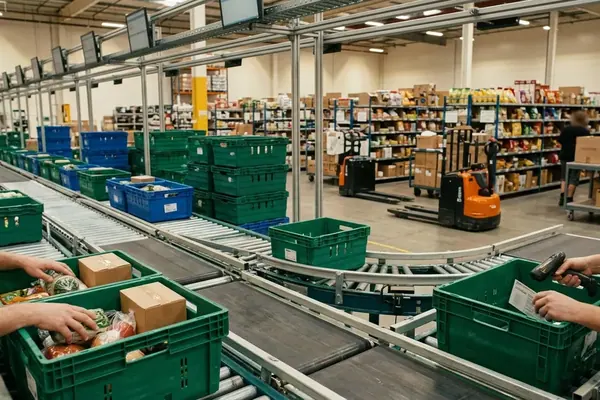
Compare structure before you infer quality. A supermarket taking pallet quantities spreads one truck stop and one loading crew across dozens of cases. A corner shop receiving three split cases absorbs the same stop across a fraction of the volume, and pays for the split on top of it. The apples may be identical.
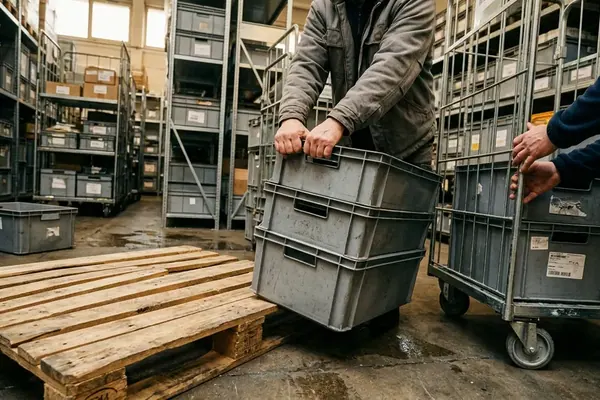
Hunts Point handles roughly 2.5 billion pounds of produce in a year. That scale stops at the wholesale platform. What you pay is set by the final 50 feet from curb to display case, a distance that can require a legal unloading position, lift-gate or ramp handling, a hand-truck transfer, a doorway clearance, and immediate placement into refrigeration before a single berry is sold.