
The Financial and Physical Toll of Poor Curb Planning
Executing a Max Delivery: 1-hour NYC grocery service requires treating the drop-off as a timed chain. A courier arriving with chilled groceries faces a strict countdown dictated by the building's infrastructure. The chain runs in order: legal stopping distance, lobby clearance, elevator transfer, and the minutes remaining before refrigeration. Perishable food should remain at room temperature for a maximum of two hours. That window shrinks to a single hour when the ambient temperature climbs above 90°F. The receiving threshold for chilled items sits at 40°F. If meat, dairy, or prepared food arrives above that mark, immediate inspection is necessary before placing it into storage. Ignoring these temperature limits risks complete order spoilage.
Relying on default app settings ignores the physical reality of dense urban blocks. A practical curb-to-refrigerator target requires roughly 10 to 20 minutes for a standard staffed-lobby handoff. When security screening or an elevator transfer enters the equation, that duration extends to about 20 to 35 minutes. First identify how long the driver can remain legally at the curb. Next, subtract the time needed for lobby access and vertical travel. If the resulting margin is only a few minutes, select a window when the recipient can meet the courier downstairs. This step protects chilled and frozen items from the second they leave the vehicle.
Temperature Control Warning: The 40°F receiving threshold is absolute. Inspect any dairy or meat arriving above this temperature immediately to prevent spoilage.
Auditing the Block for Legal Stopping Zones
Walk the delivery approach in the same direction a vehicle travels. Record the first legal stopping opportunity before and after the entrance. Read every regulation sign on that curb face. Mark hydrants, bus stops, protected bike lanes, curb cuts, scaffolding, and garage entrances. Precise measurement matters here: the 15-foot hydrant rule and the 100-foot loading boundary separate a plausible NYC grocery handoff from instructions that invite circling or abandonment. A driver scanning for a spot makes split-second decisions based on these exact distances.
New York City prohibits parking within 15 feet of a fire hydrant unless a licensed driver remains behind the wheel during daylight hours and can move the vehicle immediately. Outside restricted areas, a commercial vehicle may double-park only under defined loading conditions. This includes the absence of lawful curb space within 100 feet. The vehicle still cannot obstruct a bike lane or traffic movement. Review the NYC Department of Transportation parking regulations to confirm local enforcement patterns.
A signed truck-loading space may exclude couriers using unmarked passenger cars, forcing them into riskier parking maneuvers. Availability changes sharply by block, borough, posted hours, construction activity, and enforcement conditions. For a useful block audit, observe the entrance for 15 minutes on three weekdays. Schedule these checks once between 8:00 and 9:30 a.m., once between 10:00 and 11:30 a.m., and once between 4:00 and 6:00 p.m. A curb that appears open at noon often turns into a restricted zone by rush hour—a shift that guarantees failed handoffs.
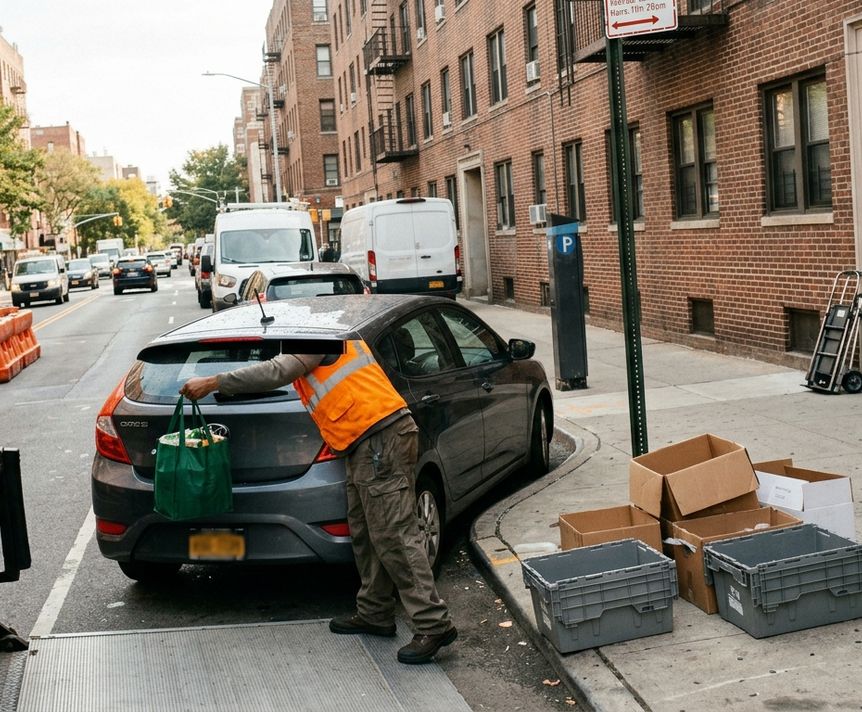
Curb Audit Tip: Conduct your 15-minute observations during the exact time slots you intend to schedule future deliveries.
Drafting Street-Level Guidance for Couriers
Write instructions in the exact order the courier encounters decisions. The sequence covers the approach street, legal stopping point, correct entrance, call or intercom action, and final handoff location. Name the cross street and the visible entrance feature before giving an apartment number. The curb decision occurs before the driver can use interior details, making lobby instructions useless if the vehicle cannot stop.
Separate vehicle guidance into a cargo-bike route and a van approach. For a cargo-bike courier, specify a legal rack or staffed curbside meeting point within one block. For a van or box truck, identify the signed loading curb and the service-door walking route from that space. Include one primary entrance and one fallback handoff point. Add a response promise of two to four minutes after the arrival call.
A workable instruction reads: "Approach eastbound on West 23rd Street. Use the signed loading area just past the service entrance, before Seventh Avenue. Avoid the glass residential lobby; enter through the black door marked Deliveries. Call on arrival; I will meet you downstairs within 3 minutes." This format guides couriers directly to the path of least resistance.
Synchronizing Internal Building Operations
Confirm the building's receiving chain before selecting the app window. Map out freight-elevator hours, reservation requirements, service-entrance locations, courier identification rules, residential-floor access policies, and doorman authority to accept food. Place the order only after verifying the full delivery window fits inside freight operations with a buffer at both ends. A mismatch here leaves perishables stranded on the sidewalk.
Keep the promised delivery window at least 30 minutes inside the freight elevator's closing time. A 3:00 to 5:00 p.m. order guarantees failure for a freight service that ends at 5:00 p.m. For buildings requiring elevator reservations, request a 15 to 30-minute slot. Confirm this booking one business day before a large grocery order or multi-cart delivery.
Give the front desk the resident name, expected arrival time, and the number of bags. Ask the desk to record the arrival time and contact the resident immediately. Collect unrefrigerated perishables within 10 minutes to prevent the lobby from becoming temporary cold storage.
Freight Elevator Booking: Secure a 15 to 30-minute freight elevator reservation one business day prior to a multi-cart grocery arrival.
Scheduling Around Gridlock and Meter Rules
Build the delivery window from direct block observations. Citywide traffic assumptions fail at the street level. On three comparable weekdays, record open legal curb spaces, active loading, bus activity, sanitation operations, and vehicle queue length at 15-minute intervals. Eliminate periods when curb regulations change or traffic repeatedly blocks the service entrance. Choose the earliest remaining 60 to 90-minute block to minimize exposure to afternoon gridlock.
Avoid selecting a window that begins or ends within 15 minutes of a posted curb-rule change. Drivers arriving at either edge frequently find the planned space unavailable. Recheck the block a day or two before a high-value perishable order. Perform a final check 30 to 60 minutes before dispatch to spot temporary construction, moving trucks, or utility work occupying the curb.
Default to a mid-morning window of 10:00 to 11:30 a.m. if your building lacks a dedicated off-street loading dock. That timeframe falls after the heaviest commuter movement and before lunch-period loading begins. Lock in the mid-morning slot, keep the freight elevator reserved, and the chilled bags move from van to refrigerator inside the two-hour limit.