
How do you know if the premium price you are paying for a Honeycrisp apple in Manhattan actually guarantees a fresher product than the one sitting in a Brooklyn corner grocer? The honest answer is that you often don't — not from the price tag, not from the lighting, not from the sign above the bin. A Manhattan apple can look more premium simply because it sits in a smaller, better-lit display, while a modest Brooklyn grocer with brisk neighborhood turnover may sell the same variety in far better eating condition.
What's Inside
- The Urban Sourcing Dilemma
- Translating USDA Grades and Supplier Language
- Identifying Shelf Rotation and Display Traps
- Reading Neighborhood Turnover Patterns
- Tactile and Visual Freshness Markers by Category
- The Final Purchasing Verdict
The Urban Sourcing Dilemma
Bottom Line: Evaluating produce in a dense city comes down to three learnable skills — reading grade language for what it actually certifies, reading shelf rotation past the misting and front-facing, and reading a store's turnover rhythm against its neighborhood. Master these three and the price tag becomes background noise.New York's produce departments run on a logistical constraint most shoppers never see: back rooms are small. Stores with limited cold storage rarely hold several days of backstock. Instead they take smaller, more frequent drops, commonly in an early-morning window from roughly 4:30 a.m. to 8:30 a.m., or a late-evening one from about 8:00 p.m. to 11:30 p.m.
That rhythm changes what "fresh" even means on a given shelf. Highly perishable items — berries, herbs, tender greens, may cycle through every day or two in a high-volume store. Hard squash, apples, onions, and potatoes can sit in the same display rotation for the better part of a week or more, kept looking full because staff keep topping off the bin.
So treat a premium price as a signal about procurement channel and how much shrink the store tolerates, not as proof of a recent harvest. The dollar figure tells you something about the buyer's ambition. It tells you nothing about the stem condition, the packaging, or how deep into the bin the newest carton actually sits. That evidence you gather yourself.
Translating USDA Grades and Supplier Language
Grade language is procurement shorthand. When you see USDA Fancy or No. 1 on a sign, you are looking at a standard built around uniformity: size, shape, color, allowed defects, maturity, and pack consistency. These designations were never designed to certify sweetness, mineral content, or same-week harvest.
Apples make the gap obvious. A higher visual grade can still describe fruit that spent months in controlled-atmosphere storage before it ever reached an NYC shelf. The apple is graded on how it looks, not on when it left the tree. Pair the grade with three physical checks: pressure against the flesh, tautness of the skin, and the condition of the stem.
High-end grocers layer on their own vocabulary. Field packed usually implies the item was packed close to harvest rather than repacked at a terminal stop. Orchard run tends to signal less sorting and more natural size variation. Both are useful hints about handling — neither is a freshness guarantee without a visible pack date or strong physical markers to back it up. You can read the full framework in the USDA Agricultural Marketing Service grading standards.
Why Organic Is Not a Freshness Proxy
Organic labeling answers a production question, not a timeline question. Organic loads sometimes travel through narrower distribution lanes; a specialized organic shipment may add a transfer step of a day or so compared with a conventional load moving through a larger regional distributor. A conventional peach on a direct regional truck can arrive at the shelf sooner than an organic one routed through a specialized hub.
Field Note: Grade and supplier language work best when you compare items of the same commodity and season. They lose almost all their meaning the moment you set a local low-grade peach beside a flawless off-season import — different games, different rules.Identifying Shelf Rotation and Display Traps
Display beauty is engineered. Produce teams mist, trim, and front-face precisely so older inventory reads as freshly stocked. The countermove is to inspect what the arrangement is designed to hide.
Start with rotation. FIFO — first in, first out, means older product should move to the front or top while newer cartons go behind or underneath. You can test this without wrecking the display: compare two or three visible layers. If the front and the layer just behind it disagree on condition, the store is rotating, and you want the fresher layer.
Important: Automated misting runs in short bursts, roughly 10 to 30 seconds every few minutes. That surface water can temporarily stiffen tired leafy greens into a convincing crispness — while the cut stems underneath stay browned, hollowed, or soft. Never judge greens by the wet leaf. Judge them by the stem.Root vegetables confess their age at the dry line. Carrots, beets, and radishes showing widened pale rings, shriveled root hairs, or rubbery shoulders have been sitting in open display long enough to lose real moisture. Retail lighting can't fix that; it only distracts from it.
Clustered items give you a single reliable tell: the stem. Grapes, tomatoes-on-vine, and bunched herbs with green, pliable stems were handled recently. Tan, brittle stems mean long shelf exposure — even when the fruit itself looks polished to a shine.
Reading Neighborhood Turnover Patterns
Classify the store before you judge the produce. The same supplier load behaves completely differently in a commuter-heavy location than in a deep residential one, because foot traffic dictates how fast each category clears.
Transit-adjacent supermarkets and stores near dense office corridors tend to show their best berry, salad, cut-fruit, and prepared-produce condition within a day of a delivery. Those categories sell hard during morning and evening rush, so the department keeps them turning. A deep residential store buys more steadily from late afternoon through about 8:30 p.m., but slower weekday turnover can leave high-priced apples, pears, and specialty citrus in the same display for the better part of a week.
Field Note: To find a store's real delivery day, read the aisles. Waxed produce cartons staged near the department, pallet wrap on end caps, flattened banana and berry boxes near the service doors, and staff breaking down mixed-load pallets during the morning hours all point to a recent drop. Shop within hours of that and you are shopping the front of the cycle.Traffic cuts both ways, though. A high-volume store may hand you genuinely fresher raspberries and herbs while showing more bruising on apples, avocados, mangoes, and stone fruit — because hundreds of customers have already squeezed and stacked the same top layer before you arrived. Fast sell-through helps the fragile categories and quietly punishes the sturdy ones.
Tactile and Visual Freshness Markers by Category
General appearance is a weak signal because each commodity fails in its own specific way. Work through the highest-risk indicator first, category by category.
Strawberries, Citrus, and Asparagus
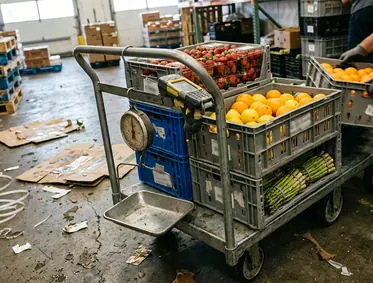
On strawberries, check the calyx before anything else. Bright green caps sitting flat against the berry suggest recent hydration; curled, browned, or dried caps usually appear before any visible mold does. The cap warns you first.
For citrus, weigh two fruits of similar size in your hands and take the heavier one. A noticeably light orange, grapefruit, or lemon often means moisture loss or thick pith relative to actual juice. With asparagus, lift a single spear from the banded bunch and bend it gently near the lower third — fresh spears resist and snap clean, while older ones bow, wrinkle at the base, or show spreading tips.
Packaging as Evidence
Clamshells talk if you read them. Condensation trapped inside a berry or salad package that has been sitting in a refrigerated case can indicate temperature swings during last-mile handling. Fogging on its own is ambiguous; fogging plus crushed fruit on the bottom is a firm warning.
Finally, check the bottom layer in any stacked bin of apples, avocados, tomatoes, peaches, or pears. Pressure bruising and concentrated ethylene show up first exactly where fruit meets cardboard, foam, or older produce beneath it. The top looks pristine; the bottom tells the truth.
The Final Purchasing Verdict
All of this converts a passive price-and-label shopper into an active evaluator — and it costs almost nothing in time. A full in-store read runs about a minute or two per category: a few seconds on label and grade language, a bit longer on rotation and display condition, and a final stretch on the tactile or packaging check.
Sequence a mixed weekly basket by fragility. Inspect berries, herbs, tender greens, mushrooms, and asparagus first, because they surrender quality long before apples, cabbage, onions, winter squash, potatoes, or citrus. Set your rejection threshold accordingly: one wet, collapsed, moldy, or leaking unit is enough to put down a whole clamshell of premium greens, while a single superficial scuff on a hard apple or orange rarely matters at all.
The rule underneath every technique here is the same. Pay the premium only when the physical evidence agrees with the claim on the sign.
So the next time you stand before a perfectly misted display of premium greens, will you trust the presentation — or will you check the stem hydration and the rotation depth before it goes in your cart?