
The speed of urban commerce relies on a fragile sequence of events that often unravels just steps from the customer's door. Break down a NYC grocery stop into shared cross-borough travel, per-order lobby clearance, elevator queue and final corridor handoff. Each phase introduces distinct variables that dictate the success or failure of a delivery window. The street-level transit operates with a predictable rhythm, guided by GPS routing and real-time traffic data. The interior journey remains a black box of architectural quirks, security protocols, and human delays that disrupt even the most optimized logistics networks.
The Final Hundred Feet: Where Urban Logistics Break Down
The final 100 feet inside a residential building often consumes more time and operational budget than the entire transit across boroughs. This reality represents a fundamental inversion of traditional logistics models, which historically focused on highway miles and warehouse sorting. Early 20th-century architecture integrated dumbwaiters and milk chutes directly into the building fabric. These features moved goods through a structure without requiring a visitor to find a resident, offering a physical solution to a physical barrier. Modern app dispatch solves a completely different problem. It gets a courier to the correct address efficiently while leaving the lobby-to-door handoff largely intact. The technology routes the vehicle perfectly, yet abandons the courier at the threshold to navigate a century-old architectural maze.
Urban logistics models now prioritize interior building navigation as the primary variable in delivery profitability. In an illustrative five-order batch, a 25-minute cross-borough drive is shared across five stops; a 7-minute lobby-to-door handoff is incurred anew at each stop. This compounding delay destroys the efficiency gains achieved on the street. The comparison changes from street travel time to per-order dwell time when the courier marks arrival at the building, not when the grocery bags reach the apartment door. Operators must account for this dwell time to maintain sustainable margins, shifting their focus from vehicle speed to pedestrian access.
Threshold Friction: Security Mandates Versus Delivery Speed
Trace the required handoff in order: locate the permitted entrance, satisfy the desk’s identification procedure, obtain resident authorization, then receive elevator or drop-zone access. Each step functions as a discrete tollbooth on the courier's time. Strict residential security measures inherently trade off against delivery efficiency. Buildings design these protocols to protect residents from unauthorized access, creating a deliberate bottleneck at the front door. Standard property management security guidelines mandate these verification layers to maintain building integrity. Logistics operators qualify their delivery guarantees based on these known lobby restrictions, recognizing that a concierge's duty to secure the premises supersedes a courier's mandate for speed.
An illustrative arrival with 90 seconds of ID logging and 2 minutes awaiting resident confirmation spends 3 minutes 30 seconds at the threshold before any elevator wait. This idle time accumulates rapidly across a full shift. A service-entrance instruction should identify the street or side of the building and the hours it accepts deliveries; 'use service entrance' alone does not tell a courier which door to approach. Vague instructions lead to perimeter searches that drain critical minutes from the route.
Egress Compliance in Lobby Design
A lobby shelf must leave entrances, corridors and other required paths of egress clear. Fire codes dictate these clearances strictly, meaning property managers must integrate delivery zones without compromising emergency evacuation routes.
Vertical Traffic: The Hidden Cost of Elevator Queues
Separate elevator delay from travel distance because the two vary for different reasons. Freight-elevator access depends heavily on specific building rules, which often restrict usage to specific hours or require advance booking by residents. Passenger elevators fill up with residents and other couriers during peak hours, creating unpredictable wait times that defy standard routing logic. The sheer volume of daily e-commerce and grocery orders compounds elevator traffic, creating measurable friction for couriers navigating high-density residential towers.
Delivery platforms model these vertical delays in their routing algorithms to predict drop-off windows. Recorded arrival-to-completion times for a building and time of day can widen drop-off estimates rather than treating every address on the same block as an equal stop. In a worked route estimate, a 4-minute permitted-elevator wait plus a 2-minute ride and corridor walk adds 6 minutes after lobby clearance. If three couriers arrive during the same elevator queue, each experiences the queue even though their street routes were independent; the relevant measurement is arrival-at-building to completed handoff, recorded by time of day. City planners monitoring urban freight initiatives recognize that interior building congestion directly impacts street-level parking availability, as delivery vehicles idle longer while couriers navigate vertical traffic.
The Physical Toll of Pre-War Walk-Ups
Multi-story stair climbs exact a severe physical toll on courier fatigue. This friction peaks with heavy grocery orders in pre-war Brooklyn and Manhattan walk-ups, where elevators are nonexistent and stairwells are often narrow and steep. Operators evaluate routes by counting loaded stair flights rather than floors alone. A fourth-floor walk-up commonly means three flights above a street-level first floor. Splitting heavy groceries into two carries doubles the loaded ascent, transforming a simple delivery into an endurance test.
A fourth-floor delivery requiring two carries involves six loaded flight ascents, plus the descents needed to retrieve the second load and leave the building. An order containing two 12-pound beverage cases puts 24 pounds into those cases alone, before produce or pantry items are added. Operators adjust order volume limits and weight distributions for routes heavily populated by walk-up architecture. They pace stops using stair counts and bag weights instead of assigning the same order volume as an elevator route. Repeated climbs directly affect courier retention and route pacing, making the human element of logistics the ultimate limiting factor in neighborhoods dominated by older architecture.
Strategic Weight Distribution
Consolidating heavy liquids into a single bag increases the risk of structural failure and maximizes courier fatigue. Distribute dense items evenly across multiple bags to facilitate safer, more balanced carries up steep stairwells.
Establishing Designated Drop Zones for Faster Handoffs
Property managers and residents must establish dedicated drop-zones to modernize interior logistics. One predictable, secure drop-zone replaces repeated door searches and resident callbacks with a defined handoff. The property manager chooses an approved lobby location, establishes access through a building-managed delivery credential or staffed desk procedure, and communicates the rule to residents. A side-street shelf can eliminate an apartment-door search, but it cannot become the holding point for temperature-sensitive grocery bags. Unrefrigerated lobby shelving is not a substitute for an attended handoff for temperature-sensitive groceries, requiring a bifurcated approach for different types of goods.
Residents then update app instructions with the correct entrance, drop-zone location, and access code. A usable instruction names the entrance and destination: 'Enter on the side-street delivery door; leave bags on the labeled shelf beside the staffed desk.' For a scheduled grocery arrival, residents can check their saved instructions and contact number before placing the order rather than waiting for a courier’s lobby call. Proactive communication eliminates the frantic threshold scramble that delays subsequent deliveries on the route.
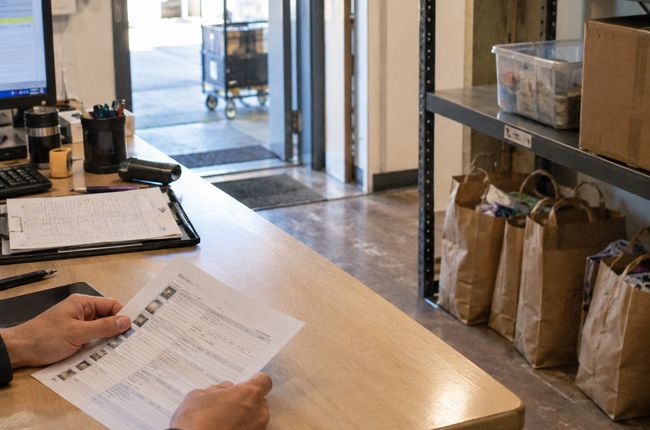
Building operators should identify the approved entrance and drop-zone location. For a scheduled grocery delivery, residents should put those details in the app instructions and arrange an attended handoff for temperature-sensitive bags.